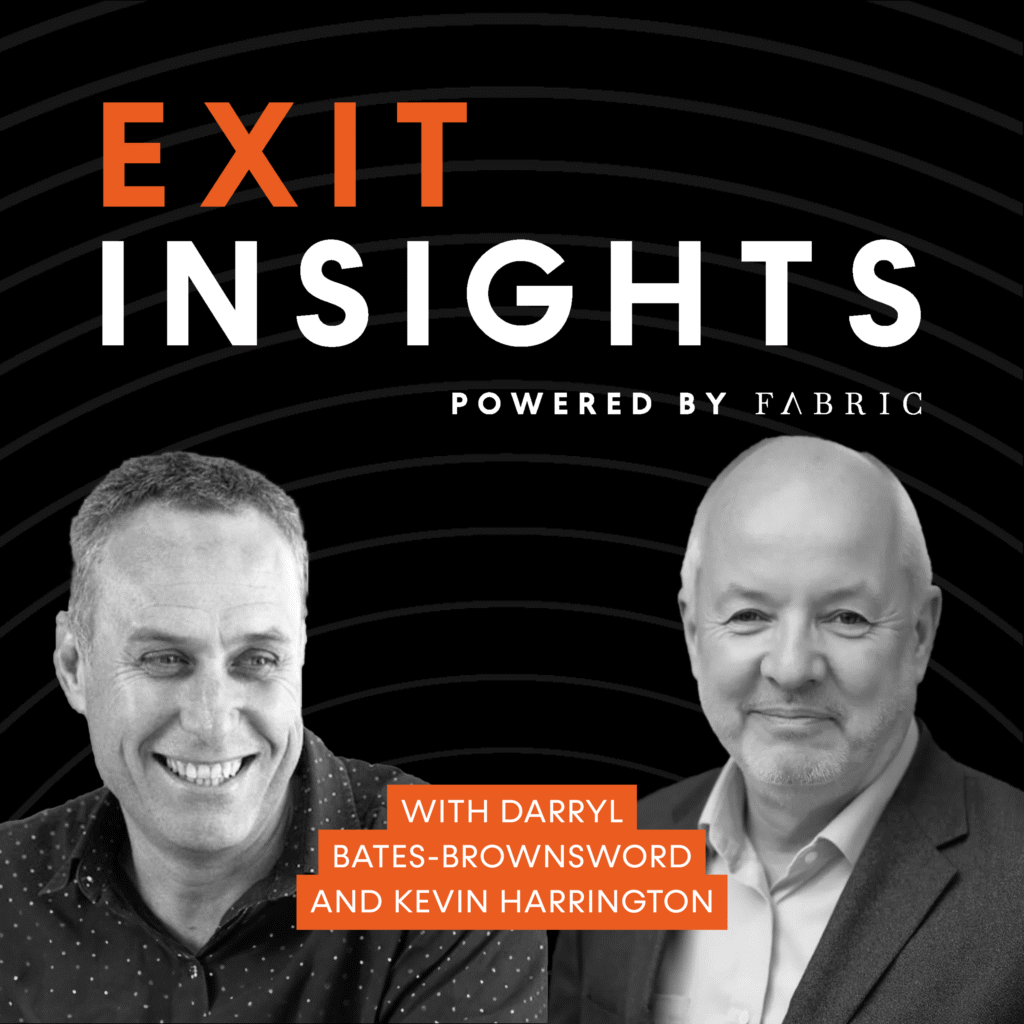
Building a Marketing Machine That Increases Your Business Value
If your business relies on one route to market – like email campaigns, face-to-face events, or social media ads – then you’re walking a tightrope. In the latest Exit Insights episode, Darryl Bates-Brownsword and marketing strategist Kevin Harrington unpack how to transform your marketing efforts into a valuable intangible asset.
Why does this matter? Because distribution channels that are predictable, repeatable, and not dependent on you directly influence your business valuation. The more resilient your marketing machine, the more attractive your business will be when it’s time to exit.
Read more: Distribution Channels: The Untapped Intangible Asset in Exit Planning with Kevin HarringtonKevin highlights how too many owners rely on luck instead of structure. Whether it’s email marketing or a rugby club sponsorship, your channels need to be trackable, scalable, and sustainable. “If you can measure how much effort delivers how much reward, you’ve built something worth buying,” Kevin explains.
Darryl adds that it’s not just about activity – it’s about reducing risk and owner dependence. “If the system only works when you shake the tree and call your mates, then it’s not a system. It’s you.”
Key Takeaways:
- Use 6–7 channels for lead generation to reduce risk.
- Build marketing systems that are process-driven, not founder-dependent.
- Storytelling connects better than features and stats – make your brand memorable.
- Own your assets: be cautious about relying on third-party platforms like YouTube or LinkedIn.
???? Whether you’re planning for succession or boosting business growth, this episode shows how marketing done right becomes a growth asset, not just a cost.
Topics Discussed
- What is a route to market?
- Why single-channel marketing is dangerous
- Turning email marketing into an intangible asset
- The risk of relying on third-party platforms
- Building trust through storytelling
- Activating sponsorships with real engagement
- The power of multi-channel marketing
- What makes marketing efforts scalable and reliable?
Actionable Tips
- Audit your current routes to market.
- Identify and strengthen weak or risky channels.
- Introduce storytelling into your messaging.
- Document your lead generation process and track outcomes.
Mentioned Tools & Ideas
- Email campaign metrics (10-3-1 rule)
- Direct mail & digital assessments
- Webinars, podcasts, eBooks
- Sponsorship activation strategies
- Story types: origin story, behind-the-scenes, customer success, and transformation
Transcript
Darryl Bates-Brownsword (00:51)
Welcome to the podcast that’s dedicated to helping business owners protect their business foundations so that they can be ready to have options and know what’s next when they’re ready for what’s next. This is the Exit Insights podcast presented by Fabric Business Solutions. I’m Darryl Bates-Brownsword and today I’ve got Kevin Harrington joining me to continue our series on building intangible assets in your business. And intangible assets will put you on the front foot. They will build
your business valuation. They will make it more attractive. They’ll make your business less dependent on you being there and that will give you options. Kevin, how are you today?
Kevin Harrington (01:33)
I’m very well indeed. Thank you, Darryl. Yes, we’re continuing our journey through the intangible assets of business has and as you said, the reason intangible assets are important is that they’re off the balance sheet and they are items that make your business much more valuable if you choose to exit. But even if you’re not exiting,
If you look after intangible assets within your business, it becomes more fun and easier to run and more profitable. ones we’ve covered so far have been, which we’ve enjoyed doing, been revenue, people, process and product. And today we’re moving on to distribution or channels. Where would you like to take this today, Darryl? Where do you want us to start?
Darryl Bates-Brownsword (02:26)
Well, look, I think… ⁓
I think we should pretend like we’re AI and talk about why this matters because whenever you ask AI a question, it comes back or my ⁓ chat GPT always comes back and says why this matters. So we should talk about why ⁓ having these intangible assets in place matter. I think we should define what we talk about distribution or routes to market are. And I think it’s worth noting at this point, like,
We’ve been talking about a number of the intangible assets that we’re familiar with. It doesn’t mean we’ve captured all of them. We’re capturing the popular ones that we see and apply to every business that we’ve worked with or seen or been involved with. We’re not claiming to be experts in implementing and bringing this home in every business. What we’re doing is going, these are the questions you need to ask. We’re looking to create awareness of the topic so that you can get a start.
And then you can bring in an expert into your business who is an expert in each of these areas because each of the areas there are experts out there who can help you with them.
Kevin Harrington (03:37)
Okay.
Darryl Bates-Brownsword (03:37)
So
let’s talk about distribution or routes to market or distribution channels or finding your or reaching your ICP. And that’s what we’re talking about today is what’s your marketing machine that has a number of distribution channels that is as close to being automated as possible. How do you turn it from a, know exactly where my next client’s coming from because all I need to do is flick this switch and here’s where my clients come from as opposed to
Hey, I hope I have clients rolling up and I’m not sure where the next one’s coming from, but yeah, I just hope it’s going to happen sooner or later. That’s what we’re talking about today. And fine tuning that so that it’s reliable to reach your ICP. So the ICP, ideal customer profile, the people who have the problem are experiencing the problem that you can solve with your IP or your process or your solution.
How’s that as an explainer? you think that captures it?
Kevin Harrington (04:41)
I think so. I would add on to that we are actually talking about B2B and B2C in many ways. I guess most of our reference points are B2B because that’s where most of our clients are or many of our clients are. But the principles are very much the same. How you do it, the detail of how you do it, how it actually looks and feels might be different if you’re selling cans of baked beans to consumers through to selling
Darryl Bates-Brownsword (04:56)
YEAH
Kevin Harrington (05:10)
large consultancy solutions that you, ⁓ Deloitte might be selling or something like that.
Darryl Bates-Brownsword (05:17)
Yeah. So it’s, it’s covering it’s a, the principles are the same, whether you’re B2B or B2C, or whether you’re selling products, hard products, or solutions as in services or promises to solve a problem.
Kevin Harrington (05:31)
Exactly.
Darryl Bates-Brownsword (05:33)
Yep. now that that’s all out of the way. what are some of the roots to market that people have? Like, yeah, I remember in the old days, in the good old days, when I first started consulting, one of the most obvious roots to market that everyone had, and it was a starting point, was the good old yellow pages. Yeah, you had to have an ad in the yellow pages. Remember those?
Kevin Harrington (05:58)
Yeah, mean, yellow pages were a fine thing, weren’t they? And Lord help the people who had business names starting with A, B or C, because they were getting inundated with phone calls. And I remember back in those days, you were better off starting with the second half of the alphabet. And you found loads of people whose phone wasn’t ringing anywhere near as much. Life has moved on. And
Darryl Bates-Brownsword (06:20)
Absolutely.
Kevin Harrington (06:21)
So the sort of thing we’re talking about is if we’re running a business, let’s take a fictitious business that is supplying a service or a product, and they’ve been happily running along for some considerable while. They’ve been sponsoring a local rugby club and they’ve been doing outbound emails, principally all they’ve ever done, to gain sufficient business. one channel there is an awareness at a rugby club, another channel there is the email.
email route. Let’s, if we get time, we’ll come back to this sponsoring our own big club, because it is quite an interesting conversation. But the email piece, what our conversation is today, is that is really two things how to maximize those email channels. And secondly, how to not be completely reliant on those email channels, and have other channels as well. Let’s kick off with the just that one channel of email to start off with.
The old rule or guideline that we all have in our minds is that if you email 10 people, and it was well targeted, you might get a chance to give three people a quote or a proposal. And out of that, you get one sale. Let’s assume those figures are dead right. 10 emails.
Darryl Bates-Brownsword (07:37)
the old 10-3-1 ratios.
Kevin Harrington (07:41)
So you’ve got 10 goes out and you end up with one sale.
Darryl Bates-Brownsword (07:45)
Yeah. 10,
10 leads, three go to a proposal and hopefully one deal that that’s the, the, the classic ratios that, ⁓ yeah, when I first did some sales training many years ago and, it’s still cited today by people that I talked to are currently delivering sales training today.
Kevin Harrington (08:03)
Yeah, it is very much that rule of thumb until you know more about a business or the lists. But yeah, it’s a very good one. So the first thing around this kind of distribution or channel using emails is, is it genuinely scalable? If you suddenly go and email 20 people, would you then get six proposals out and would you get two sales?
If you do, this is super exciting because you could do 100 and you know you’d end up with 10 customers out of it, 10 new sales out of it. And then you can manage it. You’re understanding the amount of push you have to give at certain places to get a certain amount of reward out the other end. And if you can successfully and reasonably scientifically use that data to help you manage the campaigns and to report them at the end, that’s a valuable
asset, it’s an intangible asset, because it’s not on a balance sheet. But if someone were coming along to look at your business, they would they would value you at a bit of a premium, because you’ve got this machine that can be turned up and down to make the business more successful. And that’s an important thing with any distribution channel is knowing how robust it is. If you carry on in ignorance, in ignorance around what’s going on,
It could suddenly stop working for you and then what are you going to do? So you need to understand how much push will deliver how much reward and how resilient that channel is, how sustainable is that channel. If you’re getting negative answers coming through on those things, I would suggest your business today is more luck than management and I would start a panic ⁓ and go, okay, well, how are we going to underpin this so that we’ve got a predictable business?
Darryl Bates-Brownsword (09:57)
Yeah. And the value is in its predictability and reliability. Its ⁓ success is based on following the process of acquiring those leads and then putting them through your sales process and having certain conversations and knowing that that is a tested process and it’s measured and improved and monitored. And that’s reliable. It’s not dependent on the owner, the founder of the business, you know, shaking the tree of his or her connections.
and just leveraging their connection and network personally on a regular daily weekly basis. It’s a process that is not dependent on the founders and that’s where the value lies.
Kevin Harrington (10:41)
Exactly. And that’s a kind of a start point for understanding distribution channels. And there are other distribution channels, which we’ll come on to in a second. But every one of them, it’s important you understand the sensitivity of it if things change, whether a business improves or goes down, and have an understanding of what the level of risk is for the sustainability of that option to use that channel.
And we were talking a while ago, Darryl, about YouTube and the number of people recently that have had their channels closed down. And if you’re 100 % reliant on YouTube as your route to market and your channel is closed down with no proper explanation and no method of retrieving it, your business is tantamount to being bust.
Darryl Bates-Brownsword (11:35)
Yeah. And you’re talking there about a channel that’s outside your scope of control, right? So YouTube is someone else’s platform. You don’t own the platform. And that would be similar to if you’re getting all your leads through LinkedIn or through any of the other social media channels. They’re a good channel to have. You want to leverage them as much as you can. You want to be aware of the changes in the way their various algorithms change. So if you’re utilizing ads or ⁓
or any other workshops or just posts or whatever on those channels, you need to be aware of how they’re changing and their platform and how their platform is evolving. And it also applies, if you’re doing email marketing, like email marketing every couple of years seems to go through a cycle of it being really successful and then not successful. And it’s still, I’m hearing people who still say, hey, direct mail works.
We’re having a phase. No one’s doing direct mail. You do direct mail. It’s a personal letter. Everyone loves receiving a personalized letter. It stands out. It’s different. It’s going to get read. ⁓ And there’s different ways of doing direct mail, in ⁓ direct mail, as in old fashioned through the letter box. Direct mail is what I’m talking about there. ⁓ And so there’s and what’s the most reliable system that you’ve got control of?
probably your website and a blog because you can control that. your blog is hosted on LinkedIn, that can be switched off or deleted or you can be cut out at any time.
Kevin Harrington (13:12)
So A lot of what we’re talking about works well when we start thinking about the theory and practice of communicating with people in general. That most people, when they first hear of your business, forget about you. You might say something that piques their excitement, but next day they’ll probably not remember who you were. And it’s generally accepted that between six and seven times is the sort of number of
contact points or mentions that someone needs to receive about your business before they go, aha, it’s that Darryl Bates-Brownsword from Exit Insights, he’s Fabric as well, isn’t he? We need to talk to him. And so if if all one is doing is email marketing using one channel, it is dangerous because it can go wrong on you. And it may not be sustainable,
your competitors might do it better and just spend more money and just outgun you or whatever. But bear in mind, we’re also saying that if that’s the only way people get to know about you, you’re rather minimizing your potential achievement. And if you have other channels of communication that people are receiving, you’re amplifying the value of the email you sent in the first place. So
Darryl Bates-Brownsword (14:32)
Yeah.
Kevin Harrington (14:33)
We should really be aiming to have six or seven channels of communication, whatever they might be that are suitable for your business, that are running as much under your control as possible and are validated as being reasonably secure and with perhaps a backup plan if it starts to go wrong.
Darryl Bates-Brownsword (14:51)
Yeah. So that’s so people here short time, short form content from you, long form content. ⁓ Yeah. They’ll see adverts on social media and various digital platforms. They’ll see posts popping up because of ⁓ remarketing there. You know, you can run webinars, you can run podcasts as channels, as you mentioned, and all these ways, the different ways that you get a different touch point in front of the person.
And then as you say, six or seven times, then they’ll remember you and start probing. ⁓ What’s another form? talk webinars, ⁓ some sort of online assessment, a digital assessment that talks about the problem they have and positions you as an expert at solving that problem. Like you do some sort of assessment and send a free report of that assessment as a first touch point to start to…
deliver value and demonstrate your expertise in that subject matter. A book is another one. Have you got a book or even a short book, a PDF type book that’s going to engage them ⁓ for 15 minutes or more.
Kevin Harrington (15:50)
Yeah.
Yeah, yeah, an ebooks a grand idea. You’re talking about mentioned webinars there, Darrell. Many businesses have historically used webinars or face to face events. Now the ones that doing the face to face events, when COVID came along, what happened to them? Their businesses were were shot, they didn’t have a backup plan. Some, some people were running a business where the
Darryl Bates-Brownsword (16:19)
Hmm.
Kevin Harrington (16:27)
only way they distributed the business was to organize events where people came along, either business people or consumers would come along and physically attend. And that would be the opportunity to get strong messages across and to get their purchaser to understand how it’s right for them and close them on that day with a special offer or whatever. COVID came along, who would thought something so dramatic would have happened. But businesses went
bust because they only had one route to market. And that’s dangerous. We’re not likely to have another COVID or are we? Or is it going to be something is bad? I don’t know. But this is about making our businesses robust to any conceivable change in environments and have as many channels as possible running economically and delivering stuff that
Darryl Bates-Brownsword (17:04)
yeah.
Kevin Harrington (17:21)
triggers people’s emotions and gets them to understand your business, get them understand how you’re going to make their life better, solve their problems. And most people these days when they come knocking on your door and saying, want to know about your XYZ products, have already researched your product and research the competitors. And they’ve already picked up some of your distribution channel messaging. So they largely know what they’re after.
and you end up talking to people that are just trying to do the final validation, it was the right thing for them. And the danger is that you’re gonna lose it by effectively selling them all the features and benefits for everything when they already know them. Because the channels work so well if you get them tuned.
Darryl Bates-Brownsword (18:01)
Yeah.
Sales has definitely changed over the last few years and the sales and marketing functions have blended into one. And as you say, by the time they actually meet with you, they’ve already researched you. That didn’t happen years ago. By the time they meet you now, they’ve checked you out, they’ve looked for you online, they’ve looked at your website, we’ve hardly mentioned websites today, but they’ve looked at your website, they’ve probably looked at your LinkedIn profile, they’ve googled your name and seen how it shows up.
So they’re looking to see if you’re a subject matter expert in the area that they’re looking to work on. We haven’t even mentioned PR of doing some sort of PR, but we sort of touched on sponsorships. And I know you wanted to ⁓ dig into that one a little more, Kevin.
Kevin Harrington (18:53)
Well, sponsorship is an area I get quite passionate around. It’s a great method of getting in front, getting your business in front of people that are potential buyers of your product or services. The problem is too many people think that a 300 pound banner around the side of their local rugby club is going to make any difference at all. all research shows that has no value whatsoever.
most of these banners you see around these grounds have been almost home designed in PowerPoint or whatever. You can’t read the phone number from a distance. It’s falling apart because it’s been there for two seasons. And actually, it’s basically a donation to your rugby club. And that’s not a bad thing, by the way. But
Darryl Bates-Brownsword (19:43)
Yeah, you feel good. You’re part of the local community and it’s probably if you’re in a small community and a small marketplace, it’s probably not too bad.
Kevin Harrington (19:54)
Yeah,
so step it up a little bit, step up the thinking. Sponsorship, like most marketing routes to market, ⁓ require some level of activation, some level of involvement and doing something. If you’re gonna sponsor your rugby club, spend more money. How about spending 5,000, 10,000 pounds, make a real difference and have dominant signage, but that’s still only flapping bits of plastic in the air.
Talk to the rugby club about who their members are and get access to them. Organize some events where you get a chance to speak to those people. See if you can send out one of your own newsletters to the membership. Many members of rugby clubs run businesses. They’re enormously viable customers. Set out to do something where you have to add more work and the general rule of thumb with sponsorship is…
If you spend a thousand pound on sponsorship, you need a thousand pounds worth of activity to activate the value of the sponsorship. It’s a one for one ratio. You can’t just spend the money and cross your fingers.
Darryl Bates-Brownsword (21:02)
Okay.
So if you’re gonna sponsor, you’ve got to, whatever money you put into the sponsorship, you’ve got to think of doubling that to activate that and gain access to the audience so that you’re effectively creating the two or more touch points that we talked on earlier. First touch point is they’ll see the signage at the ground. They’ll see it, but they may not take it in, but subliminally they’ll recognize it.
And then when you send out a newsletter or run some sort of workshop or a chairman’s lunch or something at the club, ⁓ your name will be seen again and there’ll start to be some familiarity and association with that. And they’re seeing those second touch points and they’ll see, yeah, this business is everywhere around this club. So something along those lines.
Kevin Harrington (21:51)
Yeah, it’s,
yeah, and the exciting thing is, if your sport’s not rugby, think the same for cricket, for hockey, for football, whatever. But I can’t remember the name of the finance company now, but it doesn’t actually matter because I know I’ll get another email from them soon. If you sign up to the Harlequins rugby club mailing list, every now and again, they get rights to send out emails to everyone on the list.
and they know who’s in business and who’s not, they’ve managed to work that one out. And they’re offering invoice discounting and ⁓ invoice factoring. So finance solutions to businesses. But their start point is entering you into a draw. Part of their sponsorship deal is they’ve got a certain number of free tickets they can use or discounted boxes or whatever. And so by entering the competition, you stand a chance of winning. Super duper, so I’m loving the brand already.
And then you answer a couple of questions about whether you could use their services or not. And if you can’t, they just leave you alone. But actually, it’s a friendly relationship with a like minded company that likes the rugby you like.
Darryl Bates-Brownsword (23:03)
Yeah, so the starting point is it’s a bit softer is what I’m hearing you say, because you’ve already both got something in common that you love that that sports team.
Kevin Harrington (23:09)
Yeah.
Yeah, surely the best way of talking to people in these distribution channels is to sit side by side with them, rather than sit face to face across a table. And that’s what they’re doing. They’re going, ⁓ you like Harlequins. Not only do we like Harlequins, we sponsor them. And actually we could get you a box for you and 11 of your friends. Free of charge, just enter this contest. We love Harlequins. You’re great as well, because you’re a fan. And then it’s a really soft set of questions.
where you don’t have to be involved with it. ⁓ But actually, I read every one of them. All the questions looked at it thought, hey, this is good. But we can do similar things in all the other channels as well. We can help people to make the channels more useful rather than just try and be transactional with them. Even with our emails, we should make them more resilient by helping people.
so they don’t just report them as spam when they’re ready.
Darryl Bates-Brownsword (24:14)
Kevin, I’m seeing a lot of advertising, promotion, blogs, posts, talking about storytelling at the moment. Everyone’s almost on the bandwagon of storytelling and
And what’s your experience around that is ⁓ as a marketer and with your marketing background, is it something that you make up stories or you use case studies? Like we want to create advocacy, but is storytelling about to be overused? Where are we at there, do you think?
Kevin Harrington (24:54)
Well, the first thing is an absolute must is every story must be authentic. And people like to know who they’re dealing with. And this could be done incredibly economically. Let me just get, I’ll give you the top five ⁓ types of short form stories that could be put into videos or into blogs or whatever. The first one would be the origin story of your business.
everyone wants to know who they’re dealing with. Are you good people? Do you have good values? Are you ethical? ⁓ Could I work with you? So the origin story is something the founder of the business can create. And it can go out in every channel you’ve got. It can go out on TikTok, can go out on Facebook, on LinkedIn, through blogs and emails and so on. So that’s the origin story. The next one would be
behind the scenes narratives about how the products are made. That done properly convinces people the products have quality, are reliable, there’s a process that works, et cetera. Customer success stories would be great short form video content or word content. We’ve all got customers that are happy to say good things about us. Otherwise, why they being customers with us for a long time? And the fourth one,
would be the kind of just like me stories, spotlighting stories of clients or partners who reflect your ideal customer. So you’re talking about the customers in the same industry. So people are seeing their peers perhaps benefiting from dealing with you. And the fifth one in my list is the stories of change and impact that talk about how innovation can help you pivot things and key moments of transformation that are powerful.
So, you there we go. Before you start, there’s five things that actually we want to know about people we’re dealing with. If we’re going to spend a lot of money with people over a long period of time, I want to know who they are, how they make the product, what the customers are saying, et cetera. And then, do you know what? I’ll give them a shout and let’s see if the individual I talk to lives up to what I’ve seen. And if they do, we’re in business.
Darryl Bates-Brownsword (27:16)
And what is it about storytelling? it that you’re engaging at a feelings or an energy at a motive human level rather than just listing out a list of features and benefits and stats? Is it the human level engagement and connection and empathy? And all that sounds like me.
Kevin Harrington (27:37)
Yes. It’s all those things, Darryl. But the trouble is, I’ve heard people think they’re telling it as a story, but deliver the list of features and benefits and the financial equations that, you know, prove that it’s the right thing. But we’re talking about proper storytelling about, you know, why did I choose to start this business? What problems are I solving? What problems did I have starting the business? And how has it grown? How’s it evolved? How’s it react to the market? And
Darryl Bates-Brownsword (27:38)
Yeah.
Kevin Harrington (28:05)
told us a proper story, the human brain’s wired up to listen to these things. And it becomes highly memorable if it’s delivered as a story. If it’s just a list of bullet points, we can’t remember more than three or four bullet points, but stories stick in our mind. And they do have absolutely, you listed out all the approaches there about the emotional content that makes us feel we’re dealing with things that are worthwhile.
Darryl Bates-Brownsword (28:32)
Yeah, we remember feeling connected, feeling engaged, feeling listened to or understood by someone as rather than being impressed by their statistical returns or what have you.
Kevin Harrington (28:47)
Yeah, what was that? ⁓ Yeah, absolutely. And storytelling feels like one half of a conversation, doesn’t it? It’s, you know, when we talk to each other as mates, friends, family, whatever, we don’t just sit there giving people bullet points. We go off at tangents, we tell stories, we…
Darryl Bates-Brownsword (28:50)
Up to your old tricks again.
Kevin Harrington (29:12)
elaborate down in certain directions to suit the individual and tell more details about that and so on. It’s what we naturally do. And that’s why that’s why it’s received so well, because it’s what we’re used to. Some people do love reading the instruction manual on things and great, those should be available as well. You know, they all that kind of technical information about products should be freely available to people don’t put friction in the way of it where
people are going to have to struggle to find it. But all buyers, be they consumer buyers, business buyers, at any level, they are all human beings, even though they cover it up occasionally. And they have emotions, let’s appeal to people’s emotional values on these things.
Darryl Bates-Brownsword (30:00)
connected to human level. Let’s show
them we understand what’s going on and pull it together. So let’s wrap this up, shall we, this episode. What have we gone through today? What have you learned from today’s episode? we’ve got a strategy. We want to build our intangible assets. And one of the intangible assets that we want to have is a marketing machine or roots to market. What is our proven process?
for reaching ⁓ the people, our ideal clients, what’s our proven process for reaching them ⁓ in a systematic way so that it’s repeatable, reliable, and not dependent on you as a business owner? If you’ve been able to create that, ⁓ then you’ve built a intangible asset around your distribution or your marketing machine.
Kevin Harrington (30:56)
a very fine summary. Now then you said I think right at the beginning of this, Darryl, that we’re not experts at all areas of distribution. We’ve got competence around a number of them, we’re very good at some as well, but we can’t do everything. So we find in our own business that once we get something going, we have to look to get someone else to come in and help us be successful around it. And
Darryl Bates-Brownsword (30:58)
beautiful.
Kevin Harrington (31:25)
To that end, I’d say to anyone that’s listening, if you want to carry on this conversation, just give us a shout. If we’re not the right people to help you, do know what? We probably know people that could, and it’s a pleasure to point people in the right direction. It’s about start the conversation and businesses that only have minimal numbers of distribution channels that are not predictable or sustainable really are reducing their perceived value to a buyer or to themselves even.
and it’s a dangerous place to be. Let’s not make that happen.
Darryl Bates-Brownsword (31:57)
Yeah, building intangible assets is all about reducing risks, creating realizable or value in your business, improving building the asset value of your business. I love it. Kevin, thanks for sharing your exit insights with me today.
Kevin Harrington (32:15)
Thank you, Darryl, talk soon.